
Why Sleep Becomes More Important Than Ever in Perimenopause

A few years ago, I learned a lesson about sleep that completely changed how I think about it.
Back in July of 2012, I was caring for a three-year-old daughter and a baby boy who was just a few months old when my dad died suddenly from a massive heart attack.
If you've ever lost someone unexpectedly, you know how devastating that can be. One day they're here, and the next they're gone. It completely turns your world upside down.
I was already exhausted from caring for a baby and a toddler, and suddenly I was trying to navigate grief on top of everything else. Eating was difficult. Sleeping was difficult. Everything felt difficult.
Thankfully, I was seeing a counselor at the time, and she told me something I had never heard before.
She said that when we repeatedly get less than six hours of sleep, our brains begin functioning almost as if we're impaired.
I remember thinking, "That can't be true."
So I looked it up.
Sure enough, research shows that being awake for 17 to 19 hours can impair performance similarly to having alcohol in your system. Reaction times slow down. Judgment becomes less reliable. Focus suffers. Mistakes happen.
That conversation stayed with me because it made me realize something important: sleep isn't a luxury. It's a necessity.
And that's especially true for women in perimenopause.
Why Sleep Matters So Much During Perimenopause
One of the most common complaints I hear from women is:
"I'm exhausted, but I can't sleep."
Or:
"I fall asleep fine, but I wake up at 2 or 3 in the morning and can't get back to sleep."
Sound familiar?
As hormones begin to shift, sleep often becomes more challenging. Hot flashes can wake us up. Anxiety can make it difficult to fall asleep. We may wake up to use the bathroom multiple times during the night. And once we're awake, our brains decide it's the perfect time to start reviewing tomorrow's to-do list.
The problem is that poor sleep doesn't just leave us tired.
When we aren't sleeping well, anxiety often gets worse. Cravings increase. Blood sugar becomes more unstable. Cortisol rises. Mood swings become more intense. We feel more irritable, overwhelmed, and emotionally reactive.
And then we wake up exhausted and wonder why we don't have the energy to cook healthy meals, work out, or take care of ourselves.
Sleep impacts everything.
What Happens When We Sleep?
Most people think sleep is simply a period of rest, but your body is actually incredibly busy while you're sleeping.
Each night, your body moves through four different sleep stages.
The first stage is light sleep. This is when you're drifting off and beginning to relax. Your heart rate slows, your body temperature drops, and melatonin begins rising.
The second stage is a deeper, more restorative stage where your muscles relax and you become less aware of your surroundings.
Then comes deep sleep.
This is where the magic happens.
During deep sleep, your body repairs tissues, supports your immune system, helps regulate appetite hormones, strengthens bones, and restores muscles. This is the stage that leaves you feeling physically refreshed.
Without enough deep sleep, you may notice more cravings, lower energy, brain fog, and a weakened immune system.
Finally, we enter REM sleep.
I like to think of REM sleep as a shower for your brain.
This is when dreaming is most active. Your brain processes information, stores memories, regulates mood, and helps organize everything you experienced during the day.
Without enough REM sleep, it's common to feel forgetful, mentally foggy, and emotionally off.
Both deep sleep and REM sleep are incredibly important, and unfortunately they're often the first things disrupted when hormones begin changing.
Why Sleep Gets Harder After 40
As women move through perimenopause, hormone fluctuations can interfere with sleep in several ways.
Progesterone, which has a naturally calming effect, begins to decline. Many women notice they feel more anxious, more restless, and less able to relax at bedtime.
Cortisol can also become dysregulated.
Ideally, cortisol should be low at night and rise naturally in the morning to help us wake up.
But many women are under so much stress that cortisol remains elevated into the evening. When that happens, melatonin production can be disrupted, making it harder to fall asleep and stay asleep.
Blood sugar swings can also play a role. When blood sugar drops overnight, the body may release stress hormones to bring it back up, which can wake you up in the middle of the night.
This is why sleep issues are rarely "just sleep issues."
Hormones, stress, blood sugar, and lifestyle habits are all connected.
The Good News: There Are Things You Can Do
The good news is that improving sleep doesn't have to be complicated.
One of the most powerful things you can do is establish a consistent sleep schedule.
Try going to bed and waking up at the same time every day, even on weekends whenever possible. This helps set your circadian rhythm—your body's internal clock.
Another simple but incredibly effective strategy is getting sunlight in your eyes shortly after waking.
Within about 20 minutes of waking up, step outside or open your blinds and expose yourself to natural light. This tells your brain it's daytime and helps regulate the hormones that control your sleep-wake cycle.
At night, do the opposite.
Reduce exposure to bright lights, televisions, phones, and screens. Blue light signals to your brain that it's daytime, which can suppress melatonin production.
I personally wear blue-light blocking glasses if I'm watching television in the evening, and I notice a difference.
Small habits like these may seem insignificant, but they can have a surprisingly powerful impact on sleep quality.
Sleep Is Your Superpower
When we're busy, sleep is often the first thing we sacrifice.
But the truth is, sleep is one of the most important things we can do for our hormones, metabolism, mood, brain health, and long-term well-being.
If you're trying to eat better, exercise more, improve your energy, balance your hormones, or reduce anxiety… start with getting more and better sleep.
Because when you're rested, everything else becomes easier.
And if you're struggling right now, please know you're not alone. So many women I talk to struggle with fatigue and exhaustion.
Your body isn't working against you.
It may simply be asking for the deep, restorative sleep it needs to heal, recover, and function the way it was designed to.
Your body needs rest, and so do you.






Hi there, I’m Jenny

I’m a Board Certified Functional Medicine Health Coach, podcast host, wife, mom of two teens, and lover of nature, farmers' markets, and a really good cup of coffee. After struggling with weight gain, anxiety, low energy, and brain fog after turning 40, I discovered a simpler, more sustainable approach to health through functional medicine and lifestyle changes. Now, I help women over 40 navigate perimenopause with realistic strategies that support hormones, energy, mood, sleep, and confidence, so they can finally feel like themselves again.
Grab The Protein Fix Guide
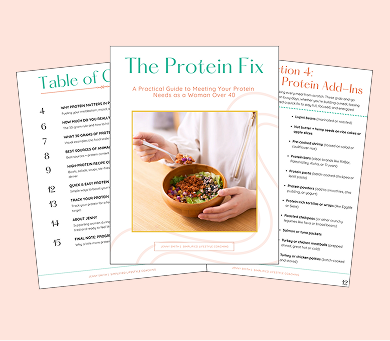
START FUELING YOUR BODY WITH WHAT IT ACTUALLY NEEDS AFTER 40.